A gas stove that clicks and clicks without lighting, or a burner that burns yellow instead of blue, is not a fault to live with — it is a fault to fix, and soon. If you are new to the Emirates, UAE Travel Brief is a useful first read on daily life here; this guide stays on the stove: the faults Sharjah technicians see most, the checks that are safe at home, and the one rule that matters more than all the others — gas work is never a do-it-yourself job.
The faults that bring gas stoves in
Most gas stove call-outs fall into a handful of patterns. The most common is a burner that will not light. The igniter clicks, or stays silent, and the gas never catches. That is usually a worn igniter, a dirty burner cap, or a faulty ignition switch — all routine repairs, but all diagnosed with the gas on, which is why they belong to a technician.
Second is a weak or yellow flame. A healthy gas flame is blue and steady, with a clear inner cone. A yellow, lazy flame means the burner is not getting enough air or the gas is not burning completely — usually because the burner ports are blocked with food and grease. A yellow flame is inefficient, it blackens pots, and it can produce carbon monoxide. It is not a cosmetic problem.
Third is a burner that lights but will not stay lit. You hold the knob, the flame catches, and the moment you let go it dies. That is almost always a failed thermocouple — the small safety device that tells the stove the flame is lit and it is safe to keep the gas flowing. It is a cheap part and a quick repair, and it is also a safety device, so it should never be bypassed.
Fourth is the smell of gas. If you smell gas near the stove, do not switch anything on, do not touch any electrical switch, ventilate the room and call a technician immediately. A gas leak can come from a loose connection, a worn hose or a faulty valve, and none of those is a job for a household. This is the one fault in this guide where the right action is to stop reading and call now.
Fifth is a knob that turns without doing anything, or a burner that cannot be turned down. Worn valves and broken knobs are common on older stoves, and they matter more than they look — a valve that will not turn down is a valve you cannot control.
What you can safely check yourself
There are only a few checks that are genuinely safe, and they are worth doing before you call anyone.
First, look at the flame. Light a burner you know works and compare. A blue, steady flame is healthy. A yellow flame, or a flame that is uneven around the ring, means the burner ports are blocked.
Second, clean the burner caps and heads properly. Lift them off, soak them in hot soapy water, and clear each small port with a pin or a soft brush. Dry them completely before putting them back — a wet burner will not light properly. This one clean solves a surprising number of weak-flame call-outs.
Third, check the obvious: the gas supply is on, the cylinder is not empty if you use one, and the regulator is connected properly. A stove that “stopped working overnight” has, more than once, turned out to be an empty cylinder.
Fourth, try a different burner. If one burner will not light but the others work, the fault is in that burner — its igniter, its cap or its valve. If none of them light, the fault is in the supply or the ignition system, and that is a technician’s visit.
Fifth, listen to the igniter. A healthy igniter makes a sharp, regular click. A slow, weak click or no click at all tells the technician exactly where to start — note which one it is.
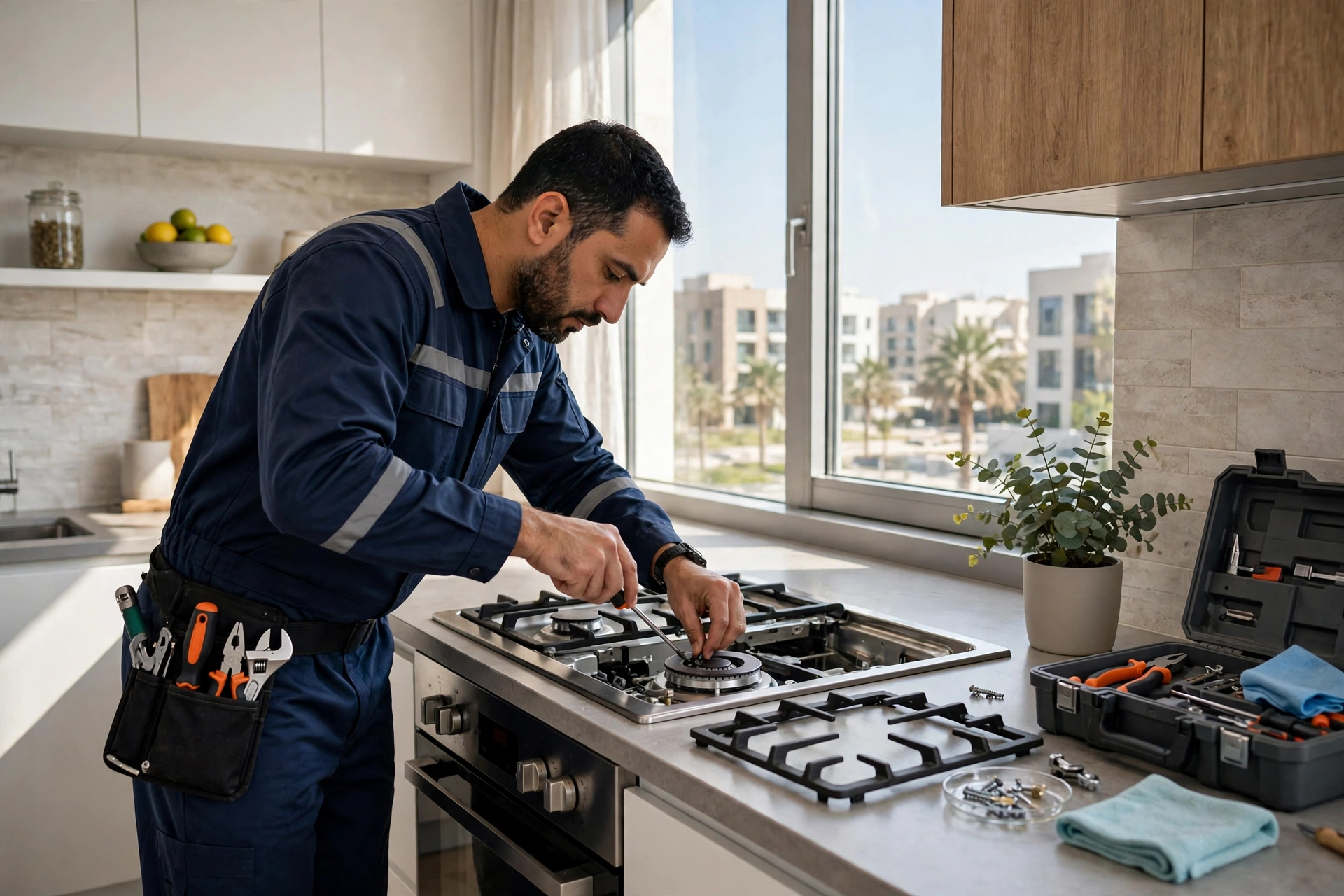
Everything else — touching the gas connections, replacing an igniter, adjusting a valve — is off limits. Gas work needs a trained technician, proper tools and a leak test after the repair. That is not caution for its own sake; it is the difference between a repaired stove and a dangerous one.
Cooktops, freestanding cookers and built-in hobs
The repair is different for each. A freestanding cooker is the easiest case: the technician can reach the valves, the igniter and the connections from the front and the back. A built-in hob is a tighter job — it has to be lifted from the worktop, and the gas connection underneath must be checked at the same time. A built-in hob that keeps failing often has a ventilation or a connection problem rather than a parts problem, and a repair visit should check both.
Older stoves deserve a note of their own. A stove that is ten years old with a failed thermocouple is a cheap repair and worth doing. A stove that is fifteen years old with a failed valve, a worn igniter and a rusted burner is a different conversation — and an honest technician will say so, rather than selling you three repairs on a stove that should be replaced.
How much should a gas stove repair cost?
It follows the part. A thermocouple, an igniter, a burner cap or a knob are all modest repairs. A gas valve or a full ignition module costs more, and on a very old stove the honest advice may be that a replacement makes more sense. That is the conversation a diagnosis-first visit is for: the fault is found, the price is explained in plain terms, and you decide with real numbers in front of you.
Our other guides follow the same approach. If the rest of the home is giving trouble, our Fridge Repair Sharjah guide covers the fridge faults that most often appear in the same homes, and our Refrigerator Repair Dubai guide covers the larger American-style units.
How to keep a gas stove safe and long-lived
A few habits add years and keep the stove safe. Clean the burner caps and heads every week — blocked ports are the single most common cause of weak flames. Wipe spills promptly; burnt-on food is what blocks the ports and damages the igniter. Never use the stove to heat the room, and never leave a lit burner unattended. Have the gas connections and the hose checked once a year — a ten-minute check catches a worn hose before it becomes a leak. And if the flame ever turns yellow, or you smell gas, stop using the stove and call a technician the same day.
In a Sharjah home where the stove runs several times a day, those small habits are the difference between a stove that lasts five years and one that lasts fifteen — safely.
FAQ
My gas stove clicks but will not light. What is wrong?
Usually a worn igniter, a dirty burner cap or a faulty ignition switch. Clean the burner caps first — if it still will not light, call a technician.
The flame is yellow instead of blue. Is that a problem?
Yes. A yellow flame means incomplete burning, usually from blocked burner ports. Clean the ports, and if the flame stays yellow, get it checked — it can produce carbon monoxide.
The burner lights but goes out when I let go of the knob. What is it?
Almost always a failed thermocouple — the safety device that keeps the gas flowing once the flame is lit. It is a cheap part and a quick repair.
I can smell gas near my stove. What should I do?
Do not switch anything on, do not touch any electrical switch, ventilate the room and call a technician immediately. Do not try to find the leak yourself.
How quickly can a gas stove be repaired in Sharjah?
Most common faults are fixed in a single visit once diagnosed. HA Fixer works 08:00–20:00 daily — call +971 54 273 0904 or +971 56 106 9456 to book a visit.
Related Reading: Ice Maker Repair Sharjah — No Ice? Fixed Fast — full guide