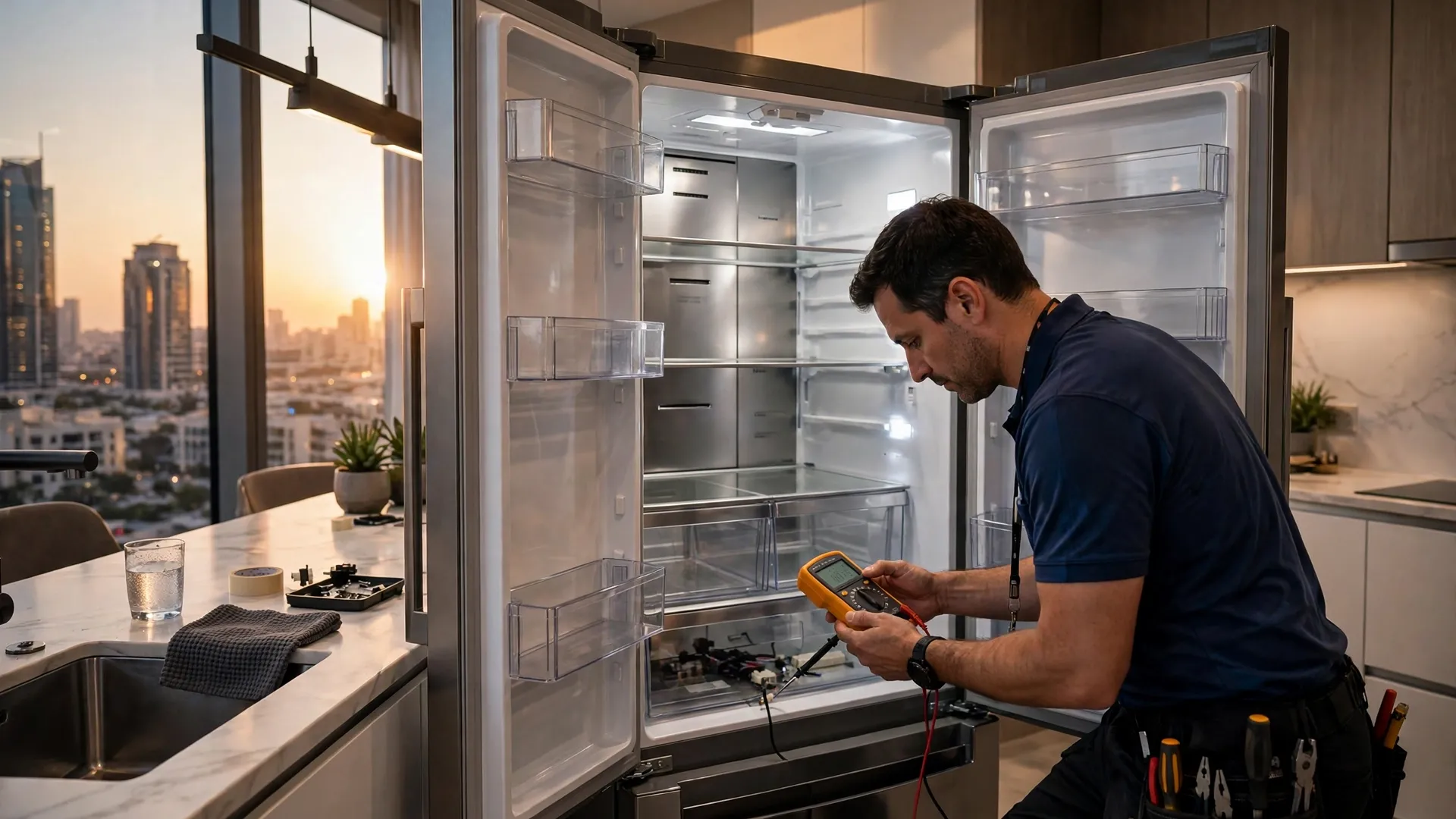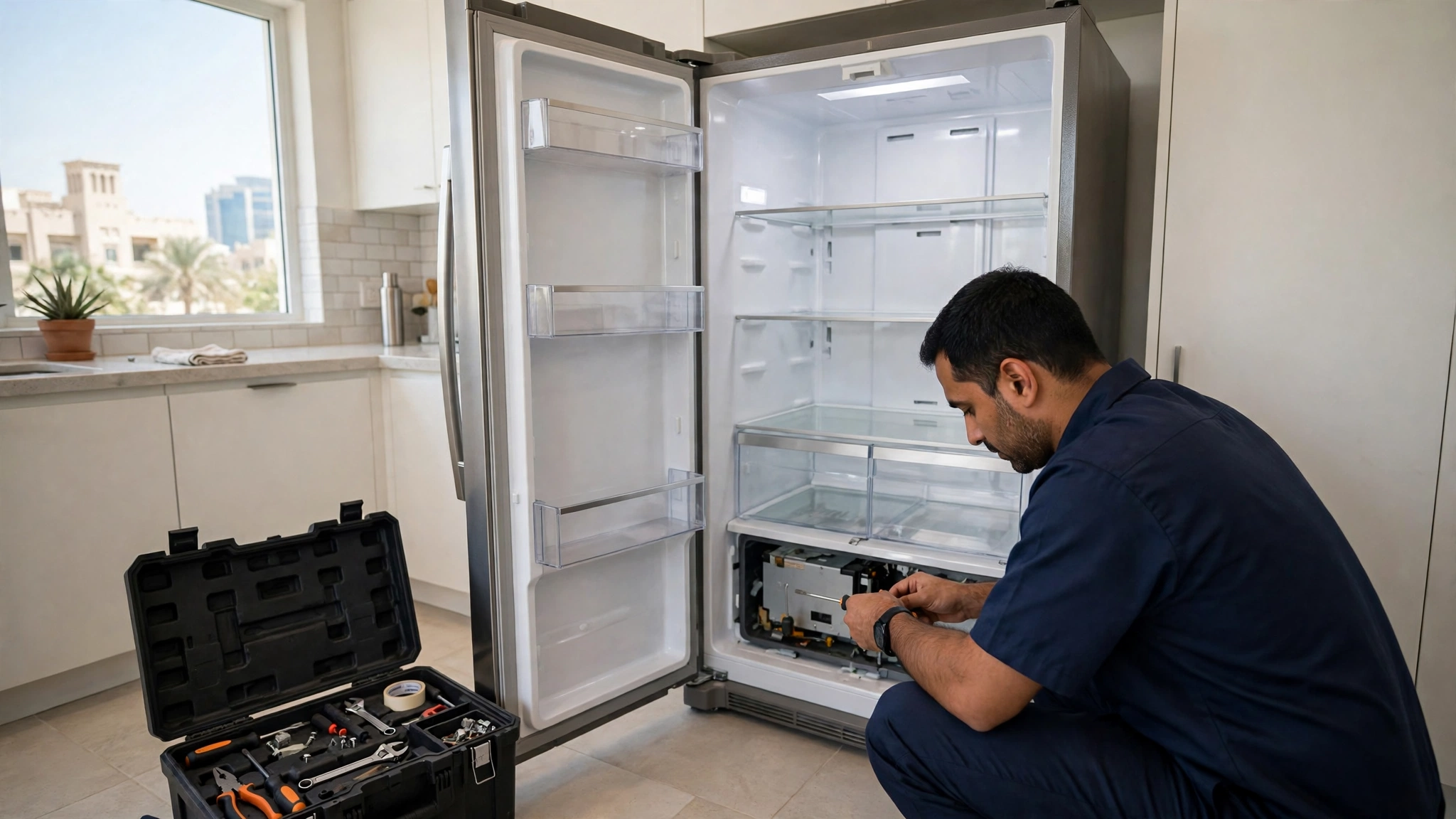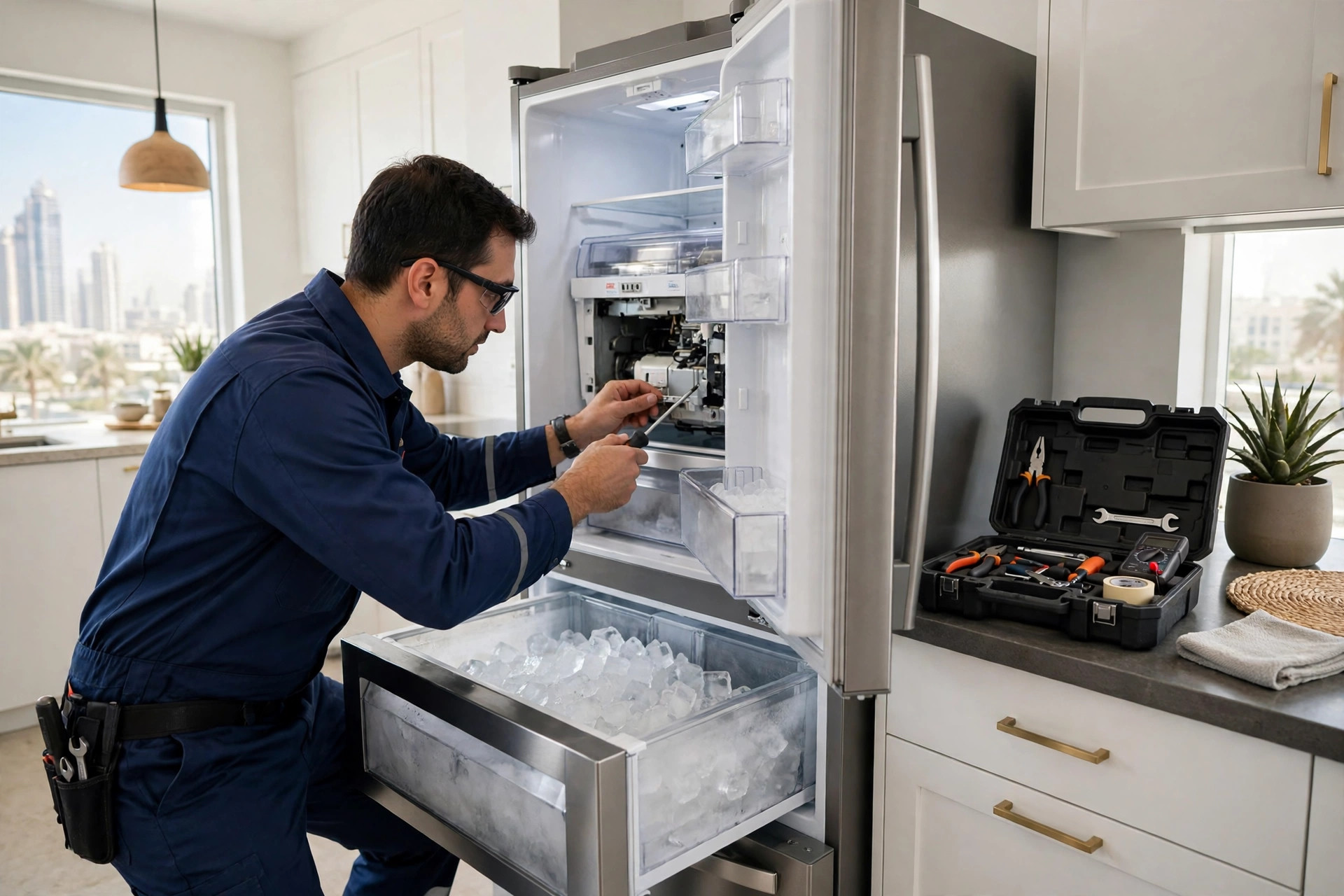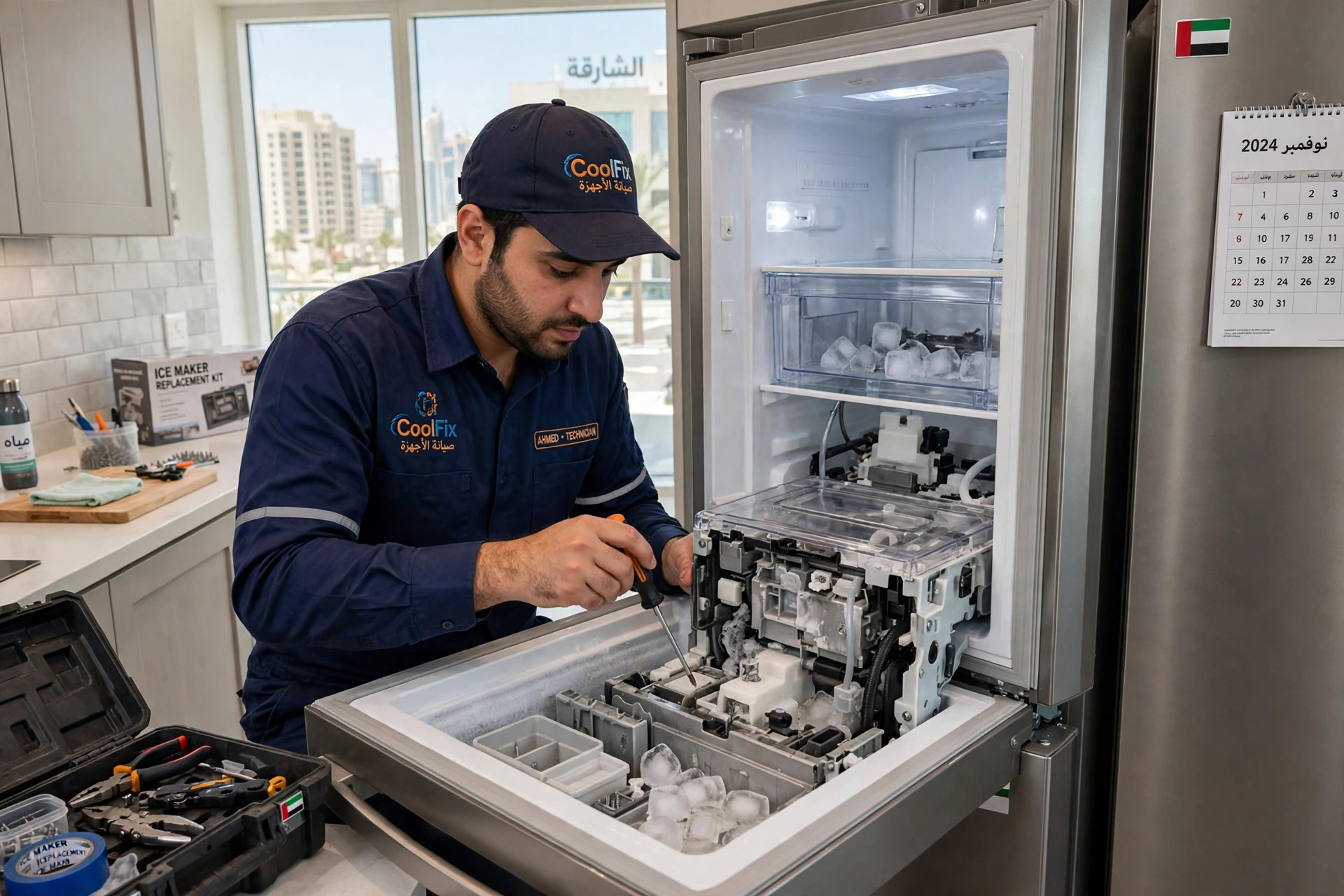
An ice maker that stops making ice rarely breaks down all at once. First the cubes get smaller, then they take longer, then one morning the bin is empty and stays empty. In Sharjah’s heat, that is not a small inconvenience — it is the difference between a cold drink and a warm one for the rest of the day. If you are new to the Emirates, UAE Travel Brief is a good place to start on settling in; this guide is about the ice maker itself: why it stops, what you can safely check, and when a technician is the right call.
No ice at all: start with the simple causes
Before anything else, check the three things that stop most ice makers. First, the water supply: the shut-off valve behind the fridge may have been knocked closed during cleaning, or the supply line may be kinked. Second, the freezer temperature: an ice maker needs the freezer at around -18°C. If the freezer has crept up to -12°C or warmer, the ice maker will slow down and then stop, long before the food in the freezer shows any problem. Third, the ice maker itself may simply be switched off — the on/off arm or switch is easy to knock when loading the freezer.
If all three check out and the bin is still empty after a day, the fault is inside the machine: a failed water inlet valve, a faulty ice maker module, or a frozen fill tube.
Slow ice, small cubes, or hollow cubes
Cubes that come out small, hollow or misshapen are almost always a water problem. Low water pressure, a partially blocked supply line, or a clogged water filter starves the mould of water, and the cubes form thin. Replacing the water filter is the first step — in Sharjah, where the water is hard and the filter works constantly, it needs changing on schedule, not when the cubes finally give up.
A fill tube that has frozen shut produces the same symptom. It usually freezes because the water inlet valve is not closing fully and lets a slow trickle through — so the real fix is the valve, not just thawing the tube.
Leaks and bad-tasting ice
Water pooling under the fridge usually traces back to the ice maker: a cracked supply line, a loose connection, or a fill tube that has slipped out of place. Switch off the water supply to the fridge and call a technician — a slow leak under a fridge can damage flooring long before anyone notices it.
Ice that tastes stale or odd is a different problem, and it is usually the filter or the freezer itself. A filter past its change date, food stored uncovered in the freezer, or a drain tray that has not been cleaned will all flavour the ice. Change the filter, cover the food, and clean the bin — if the taste stays, the supply line may need flushing.
Why ice makers struggle in Sharjah
An ice maker lives or dies by two things: cold and clean water. Sharjah gives it neither easily. The freezer works harder in a hot kitchen, so a freezer temperature that was fine in winter can drift upward in summer. And hard water scales up valves and filters faster than soft water does. The practical lesson is to treat the water filter as a consumable — change it on the manufacturer’s schedule — and to keep the freezer at its proper temperature rather than turning it down to save power, which saves nothing once the ice maker stops.
The ice maker’s problems also overlap with the fridge’s. A fridge that is not cooling properly will show it in the ice maker first, because the ice maker is the most temperature-sensitive part of the whole machine. If your fridge is also struggling, our Fridge Repair Sharjah guide covers the cooling faults that sit behind ice problems, our Refrigerator Repair Dubai guide covers the wider refrigerator, and our Ice Maker Repair Dubai guide covers the same appliance in Dubai homes.
Repair or replace the ice maker?
Most ice maker faults are worth repairing. A water inlet valve, a filter, a fill tube or an ice maker module costs far less than a new fridge, and the job is usually done in a single visit. Replacement of the whole ice maker unit makes sense when the module and the valve have both failed on an old machine, or when parts are no longer available. A technician who explains that choice honestly — before starting work — is the one to keep.
Built-in or standalone: does the type change the repair?
Most Sharjah homes have a built-in ice maker — part of the fridge, fed by the household water supply. Its faults are the ones in this guide: valves, filters, fill tubes and the module itself. A standalone ice maker, the kind found in some larger kitchens and small businesses, is a separate machine with its own compressor, and it fails differently: scale build-up on the evaporator plate is its biggest enemy in hard-water areas, and it needs descaling on a schedule, not just when the ice slows down. If you run a standalone machine, ask the technician to check the water hardness setting and the descaling schedule — a machine that has never been descaled in Sharjah will be working far harder than it should, and its ice will show it.
Whichever type you have, the same rule holds: a repair that checks only the ice maker and not the water feeding it is only half a repair.
What a repair visit should include
A proper ice maker repair checks the whole water path: the supply valve, the line, the filter, the inlet valve, the fill tube and the module itself, plus the freezer temperature. It should also include a check of the fridge’s cooling, because an ice maker fault caused by a warm freezer will come straight back if the fridge is not fixed too.
HA Fixer covers Sharjah, Dubai and Ajman, open 08:00–20:00 daily. Call +971 54 273 0904 or +971 56 106 9456 to book a visit.
Keeping an ice maker healthy
Change the water filter on schedule. Keep the freezer at -18°C. Clean the ice bin regularly and throw away ice that has sat for weeks. Do not store food uncovered in the freezer. And once a year, have the supply line and the inlet valve checked — a small leak caught early is a ten-minute fix, and a leak caught late is a new floor.
FAQ
Why is my ice maker not making ice?
Check the water supply valve, the freezer temperature (around -18°C) and the ice maker’s on/off switch first. If those are fine, the inlet valve, module or fill tube needs testing.
Why are my ice cubes so small?
Usually low water pressure, a clogged water filter or a frozen fill tube. Change the filter first — it is the most common cause in Sharjah’s hard water.
Why does my ice taste bad?
A filter past its change date, uncovered food in the freezer, or a dirty ice bin. Change the filter and clean the bin; if the taste stays, the supply line may need flushing.
Is it worth repairing an ice maker?
Yes, in most cases — a valve, filter or module costs far less than a new fridge, and the repair is usually done in one visit.
Do you repair ice makers in Sharjah?
Yes — HA Fixer serves Sharjah, Dubai and Ajman, 08:00–20:00 daily. Call +971 54 273 0904 or +971 56 106 9456 to book.