In a Dubai kitchen, the ice maker is one of those quiet conveniences you only notice when it stops. One morning the bin is empty or a puddle is spreading across the floor. With summer past 40°C for months, a working ice maker matters more here than almost anywhere else — especially when relatives are visiting Dubai.
Most ice maker faults are small: a frozen water line, a tired inlet valve, a filter unchanged for two years. This guide covers what is going wrong, what you can check yourself, and when to call a professional. If your refrigerator ice maker is not working properly, start here.
Why ice makers struggle in Dubai homes
Dubai is hard on ice makers. The machine runs almost non-stop through a seven-month summer, and the water carries more dissolved minerals than many manufacturers design for. Limescale builds up inside valves and moulds faster here, and a fridge opened twenty times a day struggles to hold minus 18°C. Faults that look sudden usually are not — a valve narrowed by scale for a year finally sticks shut one August afternoon.
Ice maker not making ice at all
An empty bin is the most common complaint.
Check the obvious first
Make sure the ice maker is switched on. It accounts for a surprising number of call-outs: a control arm knocked up into the off position during cleaning, or a unit turned off before a holiday and never turned back on. The arm should sit down; raised, most machines stop producing. Allow 24 hours to fill a bin from empty.
Water supply and internal parts
If the machine is on and still nothing appears, suspect the water supply. The shut-off tap behind the fridge may be closed or clogged with scale, and the thin plastic water line can kink when the fridge is pushed back against the wall. Never force a frozen line with heat — the plastic cracks and floods the kitchen.

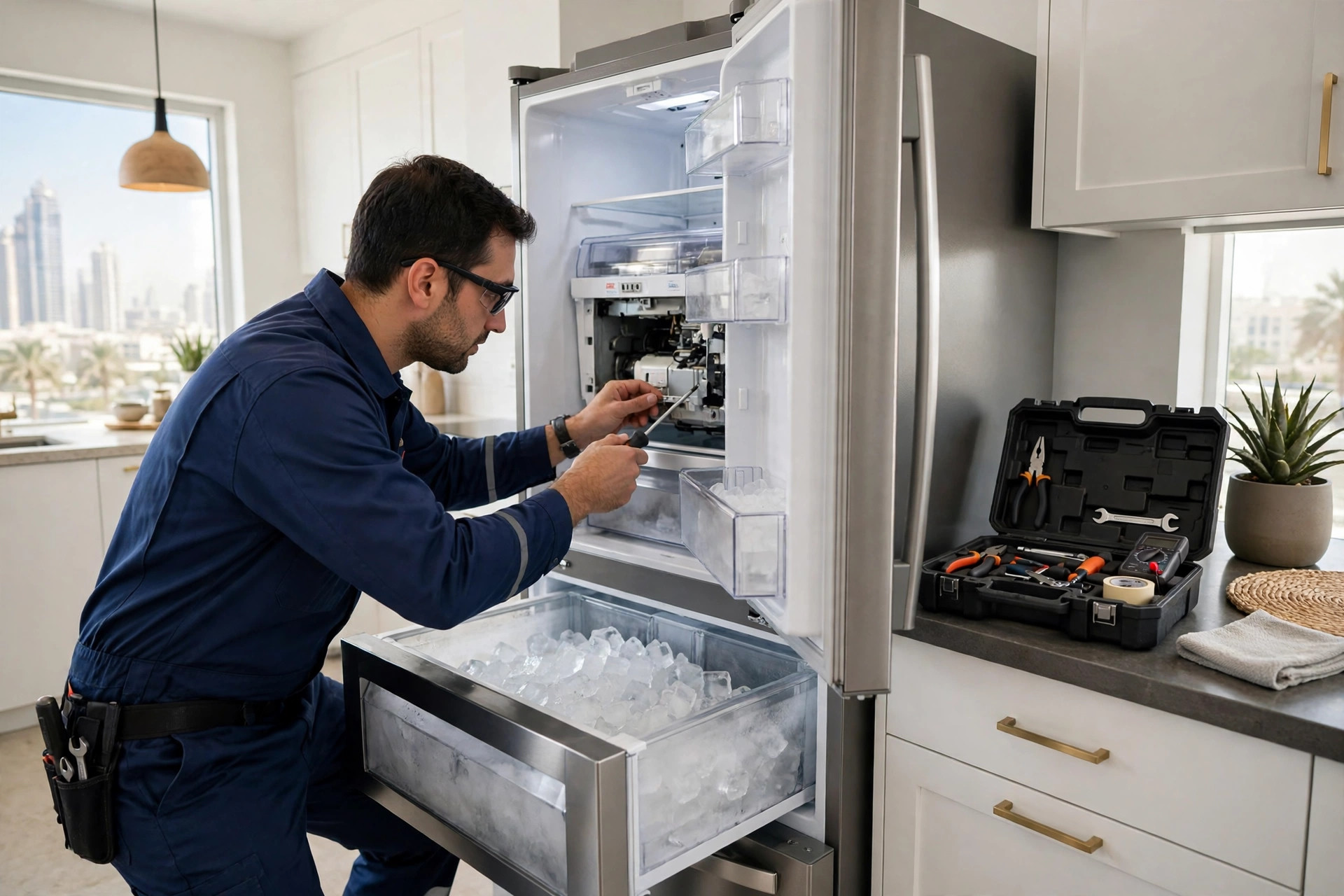
When water reaches the machine but no ice forms, the fault is usually inside: a water inlet valve that no longer opens, a failed mould heater, or a motor module that has stopped turning the ejector arms. These need proper diagnosis.
Slow ice, or small and cloudy cubes
An ice maker that works, but slowly, is usually telling you about temperature or water flow rather than a broken part. The freezer must hold a steady minus 18°C. A worn door seal, an overpacked freezer, or dusty coils will all push the temperature up and stretch each batch. Small, hollow cubes point at restricted water flow — a clogged filter, a scaled valve, or low water pressure. Cloudy cubes are harmless mineral deposits; a fresh filter usually clears them.
Bad taste or smell in the ice
Ice absorbs odours — a forgotten container of leftovers can flavour your drinks for a week. But if the smell survives a clean-out, the cause is usually the water filter, or the absence of one. Filters last about six months, and once exhausted they stop removing the chlorine and sediment that give ice its chemical taste. In Dubai, a spent filter shows up in the ice sooner than the manual suggests.
Empty the bin, wash it with warm water and bicarbonate of soda, wipe the freezer, and throw away the first two batches after a filter change. If the taste returns, the housing or water line may harbour mould or scale. Our wider fridge repair in Dubai service covers the whole appliance.
Water on the kitchen floor
A leak is the one ice maker symptom you should never ignore, because water damage in an apartment spreads fast — into the cabinetry, under the flooring, and in the worst cases into the flat below. The usual culprits are a cracked water line connection, a split inlet valve, or a frozen-over freezer drain. Turn off the water supply first, mop up, and watch where fresh water appears. Treat it as urgent even if the ice maker still works.
Strange noises from the ice maker
Ice makers are not silent — a healthy one clicks as the mould fills, hums as the water runs, and clunks as cubes drop. Loud buzzing usually means the inlet valve is trying to open against a blocked line. Grinding points to the ejector motor struggling against cubes frozen together in the mould. A constant high-pitched whine is more often the evaporator fan, which can ice up when the freezer temperature is unstable.
Switch the ice maker off and listen again. If the noise stops with it, the fault is in the ice maker; if it continues, the problem is elsewhere in the fridge. A new, loud noise is worth a check before it becomes a breakdown.
Repair or replace: how to decide
Most ice maker faults are worth repairing. Valves, filters, motors and control modules are all replaceable, and on a fridge that is otherwise cooling well, a single-part repair restores the machine fully. The calculation changes in three situations. First, age: on a fridge over twelve years old with past cooling repairs, more money into the ice maker may be throwing good after bad. Second, repeated failure: three repairs in eighteen months means the rest is wearing out too. Third, parts availability — some older models have parts no longer made, and a repair that waits weeks for a part is no repair at all.
Maintenance tips that actually prevent call-outs
- Change the water filter on schedule — every six months is the standard; in Dubai’s hard water, do not stretch it to twelve.
- Keep the freezer at minus 18°C and don’t overfill it. Air needs room to circulate around the ice maker mould.
- Clean the ice bin monthly. Wash it with warm water and bicarbonate of soda, and let it dry before replacing it.
- Vacuum the condenser coils twice a year. Dust on the coils makes the whole appliance run hotter and longer.
- Use the ice regularly. Ice that sits for weeks fuses into a block that jams the ejector arms.
These small habits cost nothing, but they keep an ice maker running for years. The same logic applies across the kitchen, from dishwasher repair to cooker hood repair.
When to call a technician
Call a professional for water connections, electrical parts, or anything inside the sealed mechanism — inlet valves, motors, control boards and frozen internal lines. A wrongly fitted valve floods a kitchen, and a control board fault misdiagnosed as a valve fault wastes money twice. Call too if the fridge itself is not cooling properly — an ice maker fault is often the first sign of a wider cooling problem. A routine AC servicing visit alongside the repair can save a second call-out.
HA Fixer covers the whole of Dubai, seven days a week, 08:00 to 20:00. Call +971 54 273 0904 or +971 56 106 9456, or visit the workshop at Shop 6, GB Building, Al Karama, Sheikh Hamdan Colony, Dubai. Diagnosis comes first, with a clear estimate before any work starts.
Frequently asked questions
Why has my ice maker suddenly stopped making ice?
Usually the control arm was knocked off, the water valve is closed or clogged, the line is kinked or frozen, or the inlet valve has failed. Check the arm and supply first, allow 24 hours, and if nothing appears, a technician needs to test the components.
How long should an ice maker take to fill the bin?
A healthy ice maker produces a batch every 90 minutes to two hours and fills an empty bin in about 24 hours. If it takes two days or more, the freezer is too warm, the water flow is restricted, or the filter needs changing.
Is it safe to drink ice that tastes strange?
Cloudy ice from minerals is harmless, but ice with a strong chemical or musty taste should not be used until the cause is found. Change the filter, clean the bin, and discard the first two batches. If the taste persists, have the water line checked.
Can I fix an ice maker myself?
You can safely check the switch and control arm, the water tap, the filter, and the bin and freezer. Water line connections, the inlet valve, the motor and the control board belong to a technician — a mistake there causes flooding or electrical damage.
Should I repair my ice maker or buy a new fridge?
Repair it in most cases — valves, filters and motors are replaceable, and one repair costs far less than a new fridge. Replace only if the fridge is very old, the ice maker has failed repeatedly, or the part is no longer made.